
Paid ads work exactly as long as you keep paying for them, that’s what it’s named on. The moment the budget stops, so does the traffic. SEO is the only channel where the traffic you earn this month keeps working for you next month, and the month after that. Which is why more ecommerce brands are shifting spend away from ads and into ecommerce SEO services to get organic traffic growth that build continued visibility instead of renting traffic for short time.
I’m Ramay, and this is the same strategic framework I use with ecommerce clients. You’ll get ranking pillars that actually move rankings and revenue for ecommerce stores with real catalogs, real category structures, and real deadlines. You can schedule a conversation with me at abdullahramay.com if you want the bigger picture for your brand beyond this one guide.
Quick summary: Ecommerce SEO succeeds or fails on five things: keyword mapping by shopping intent, technical crawlability at scale, on-page optimization of category and product pages, content that builds topical authority, and link/trust signals. Below, each pillar comes with the “why,” plus a real-world style example so you can see how it plays out on an actual catalog, not just in a checklist.
What Makes Ecommerce SEO Different From Regular SEO
General SEO is mostly built around ranking blog posts and informational content driving Top Of the Funnel (TOFU) audience. Ecommerce SEO is built around ranking category pages, product pages, and the shopping-intent keywords that sit directly upstream of a sale. And most importantly, building a brand’s online presence in Google and AI platforms. That difference sounds small, but it changes almost everything about how the work gets done.
Online stores face these common issues that content-driven websites rarely face:
-
- Large product catalogs: hundreds or thousands of SKUs make it genuinely difficult for search engines to crawl and rank every page without a deliberate structure and unique ICP content behind it.
-
- Multi-layered category hierarchies: a Category → Subcategory → Product structure only works for SEO if the content, internal linking and page relationships are explicit, not copied.
-
- Indexation bloat: filters, sort options, and URL parameters, language parameters can spin off thousands of near-duplicate URLs that quietly drain your crawl budget.
-
- Duplicate product variants: the same product in five colors and four sizes is a canonicalization problem waiting to happen if it’s not handled early.
-
- Category pages doing double duty: most high-intent traffic lands on category pages first, so those pages need to rank and convert, which is a harder brief than a typical landing page.
These are exactly the kind of structural problems that generic SEO advice glosses over and exactly why brands searching for ecommerce SEO services usually need something more specialized than a general marketing retainer. This is typically the first thing worth auditing before writing a single line of new content.
The 5 Pillars of an Effective Ecommerce SEO Strategy
1. Keyword Research Built Around Shopping Intent
Keyword research decides which buyers find you and which page they land on when they do. For ecommerce, that means sorting keywords by intent before you sort them by volume or difficulty:
-
- Transactional keywords capture people ready to buy: Think “buy healthy meal kit.” These belong on product pages.
-
- Commercial/comparison keywords: Attract shoppers still weighing options – “best morning meal plans”. These fit category pages or comparison content.
-
- Long-tail keywords target narrow, specific searches: “Organic Apple Cider Vinegar with Mother” and often convert at a higher rate because the intent is so precise.
From there, hierarchical keyword mapping matters as much as the research itself: Depending on your niche – high-volume head terms go on category pages, more specific variants go on subcategories, and long-tail terms go on individual product pages (tiered decision process). Get this backwards – say, targeting a broad head term on a single product page — and you’re fighting your own site structure for rankings and conversion.
Practical example: A store selling hiking gear might map “hiking boots” to its main category page, “waterproof hiking boots” to a subcategory, and “Salomon X Ultra 4 waterproof size 10” to the exact product page. Each page now has a keyword it can realistically win, instead of three pages competing for the same term.
2. Technical SEO Foundations for Ecommerce Platforms
Content and links don’t matter if search engines can’t crawl and index your site efficiently. Write the best content for your category/product pages, it’s valued zero if remained ‘Unindexed’. Technical SEO is not too technical for me but I consider it the foundation everything else sits on:
-
- Crawl budget optimization: Google allocates a finite amount of crawling attention to your site. Trimming low-value, parameter-heavy URLs frees that budget up for pages that actually matter. Keep a track on your sitemap.
-
- Clean URL structure and canonical tags: Descriptive, simple URLs plus correctly implemented canonicals prevent filter and variant pages from cannibalizing your “real” pages in search results. So no multiple pages would compete with each other for ‘Single Query’.
-
- Schema markup: Structured snippets data tells search engines (and increasingly, AI-driven answer engines) exactly what a page is: product, price, availability, review rating. This directly affects your odds of showing up in rich results and AI Overviews.
-
- Mobile-first performance and Core Web Vitals: Most ecommerce traffic is mobile. Slow load times and shifting layouts cost you both rankings and conversions simultaneously.
A quick reality check: My clients get a detailed video Audit -> Get Yours
I start by Auditing crawl budget, fixing canonical logic, and rolling out schema markup across money SKUs is realistically a full-time project on its own. Before you’ve written a single piece of content. This is precisely the kind of work an ecommerce SEO consultant handles.
3. What are the Key On-page SEO Strategies for Ecommerce Business
Once the technical layer is solid, the pages your customers actually land on need their own attention:
-
- Titles and meta descriptions that include the relevant keyword and match what the searcher is actually looking for, not a generic template repeated across every SKU.
-
- Category pages that do more than list products: Descriptive intro copy, useful filters, and product highlights that give Google (and the shopper) context, not just a grid of thumbnails.
-
- Internal linking between related categories, products, and guide content. This spreads ranking authority across the site and keeps shoppers moving instead of bouncing.
4. Content Strategy That Builds Topical Authority
Content is how you signal expertise to both search engines and shoppers who aren’t ready to buy yet:
-
- Buyer guides and comparison content meet shoppers in the research phase and capture high-intent traffic before a competitor does.
-
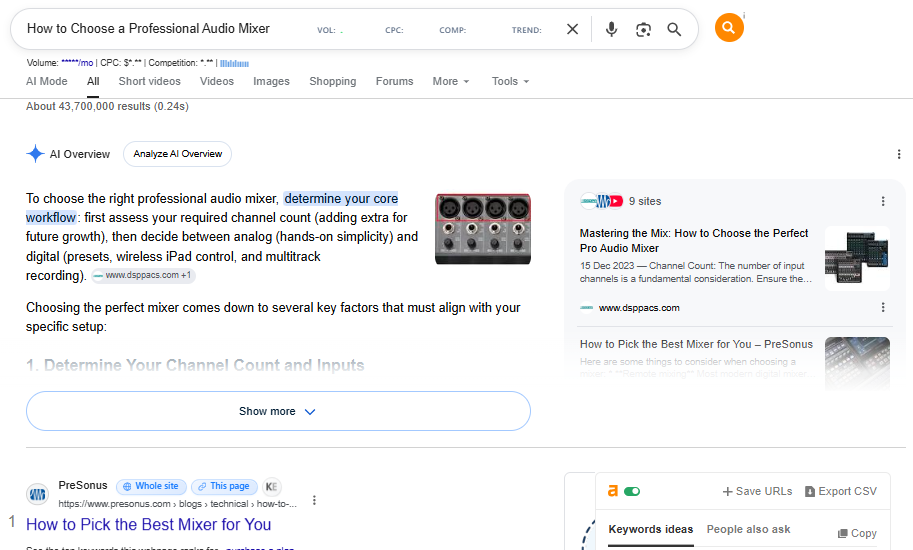
- Trend and educational content: Something like “How to Choose a Professional Audio Mixer”, pulls in early-stage searchers who convert later, often once they trust the brand.
-
- Content clusters: Groups of interlinked articles around one theme, build the kind of topical depth that both Google and AI answer engines reward with visibility.
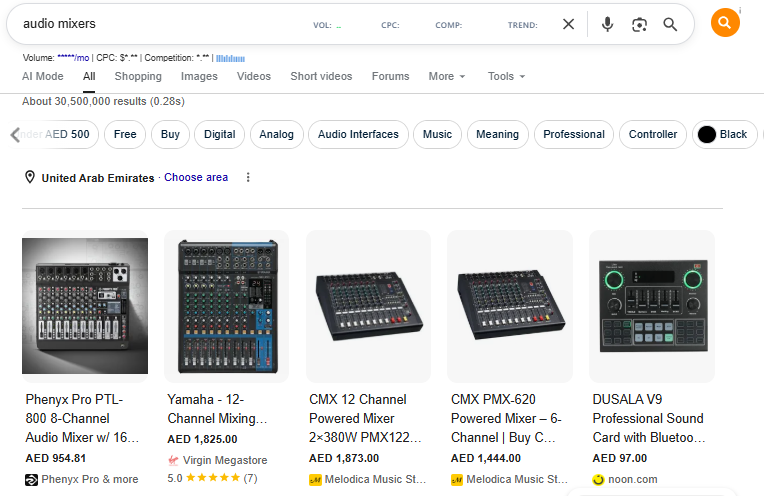
Practical example: Instead of publishing one isolated post about “audio mixers,” build a cluster: a buyer’s guide, a comparison of mixer types, a troubleshooting guide, and a “best for beginners” roundup. All internally linked to each other and to the relevant category page. Individually, each piece is modest. Linked together, they read as genuine authority on the topic, which is exactly what earns rankings for the harder, higher-volume terms.
5. Link Authority and Trust Signals
Search engines rank sites they trust more highly, and trust is built, not claimed:
-
- Strategic outreach and PR: Links from business listings, forums, communities, credible, relevant publishers signal that outside sources vouch for your site.
-
- Review schema and user-generated content: Cerified reviews build trust with shoppers and give search engines a genuine trust signal, not a manufactured one.
-
- Third-party mentions and citations: Even unlinked brand mentions from respected sources reinforce authority over time.
What’s Actually Included in an Ecommerce SEO Package
A complete package should cover six things working together, not in isolation:
-
- Technical SEO audit – crawlability, indexation, site speed, Core Web Vitals.
-
- Keyword strategy – intent-mapped keywords assigned to the right page type.
-
- On-page optimization – titles, meta descriptions, category and product page 80+ points in on-page SEO.
-
- Content development – buyer guides, educational content, and content clusters.
-
- Authority building – outreach, review schema, and trust signals.
-
- Performance reporting – clear visibility into rankings, traffic quality, and – critically – organic revenue, not just impressions.
When you work with an ecommerce SEO consultant instead of assembling these six pieces from separate freelancers or tools, they move together instead of stalling out individually. Which is usually where DIY ecommerce SEO efforts lose momentum and waste resources if compared on ROI.
Frequently Asked Questions
What are ecommerce SEO services? Ecommerce SEO services are optimization strategies built specifically to help online stores rank higher for category pages, product pages, and shopping-intent keywords — as opposed to general SEO, which centers on informational content.
What’s the difference between ecommerce SEO and regular SEO? Regular SEO optimizes for informational search intent. Ecommerce SEO optimizes for product data, category hierarchy, indexation at scale, and purchase-intent keywords that lead directly to a sale.
How long does ecommerce SEO take to show results? Most stores start seeing measurable movement within 3–6 months, though this varies with site size, competition, and how quickly technical fixes get implemented.
Can SEO actually reduce ecommerce advertising costs? Yes! consistent, high-intent organic traffic reduces reliance on paid ads over time, which lowers overall customer acquisition costs even if it doesn’t replace paid channels entirely.
What should I look for in an ecommerce SEO consultant? Look for hands-on experience with large catalogs, a track record with indexation and technical issues specific to ecommerce, and reporting tied to organic revenue rather than surface-level metrics.
Bringing It Together
None of these five pillars work particularly well in isolation. Technical fixes without content leave you crawlable but invisible on the terms that actually convert. Content without technical SEO gets built on a foundation that can’t hold rankings. The brands that pull ahead treat this as one connected system, run by one accountable partner, rather than a patchwork of disconnected fixes.